
Introduction
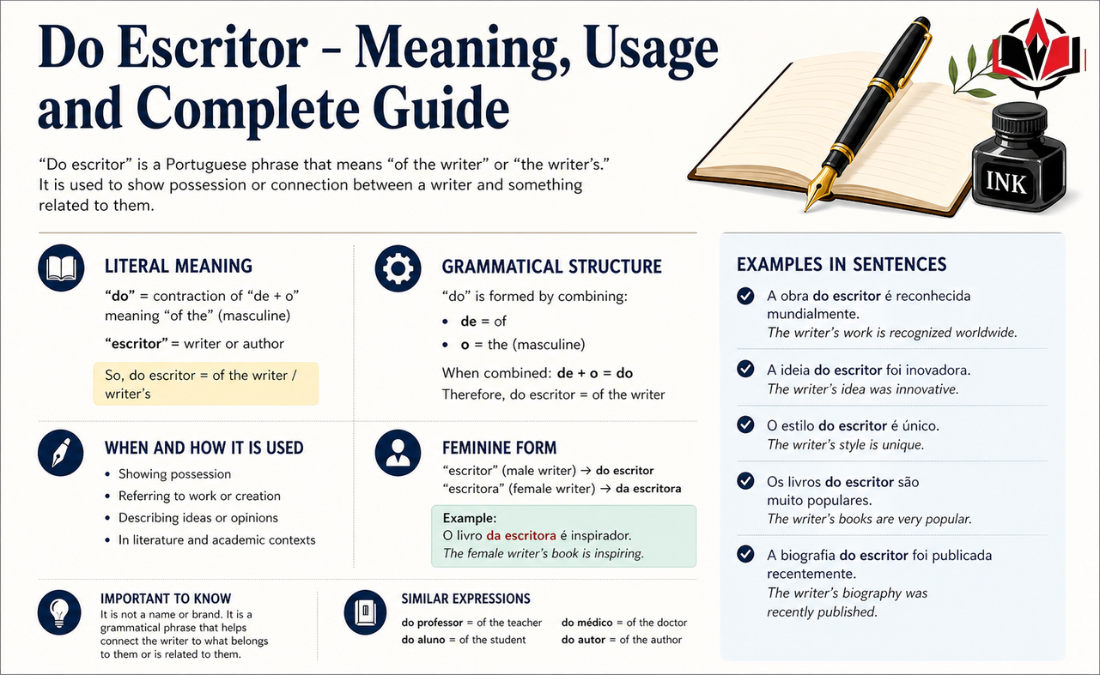
The phrase “do escritor” comes from the Portuguese language and is commonly used in everyday writing, literature, and grammar. Although it may look like a proper name or a brand at first glance, it is actually a grammatical expression that carries a very simple meaning.
In English, “do escritor” translates to “of the writer” or “the writer’s”, depending on the context. It is used to show possession or connection between a writer and something related to them, such as their work, ideas, or identity.
This article provides a complete explanation of what “do escritor” means, how it is used in sentences, its grammatical structure, and why it is important in the Portuguese language.
Literal Meaning of “Do Escritor”
To understand the phrase clearly, we need to break it into two parts:
- “do” = contraction of “de + o”, meaning “of the” (masculine form)
- “escritor” = writer or author
So, when combined:
do escritor = of the writer / writer’s
This shows possession or association. It is similar to the apostrophe “’s” in English grammar.
Example Translation:
- Portuguese: O livro do escritor é famoso.
- English: The writer’s book is famous.
Grammatical Structure of “Do Escritor”
Portuguese uses contractions to express relationships between words. “Do escritor” is formed from:
- de (of/from)
- o (the – masculine singular article)
When combined, they form “do”.
Breakdown:
| Portuguese | Meaning |
|---|---|
| de | of |
| o | the (masculine) |
| do | of the |
So:
- do escritor = of the writer
This structure is very common in Portuguese and appears in many everyday expressions.
When and How “Do Escritor” Is Used
The phrase is used whenever something belongs to, is created by, or is related to a writer.
1. Showing Possession
It is used to show that something belongs to the writer.
- A caneta do escritor
→ The writer’s pen - O estilo do escritor
→ The writer’s style
2. Referring to Work or Creation
It can refer to something created by a writer.
- A obra do escritor é reconhecida mundialmente
→ The writer’s work is recognized worldwide
3. Describing Ideas or Opinions
It can describe thoughts or ideas belonging to a writer.
- A ideia do escritor foi inovadora
→ The writer’s idea was innovative
4. In Literature and Academic Contexts
It is widely used in books, essays, and academic writing in Portuguese.
- A linguagem do escritor é simples e clara
→ The writer’s language is simple and clear
Feminine Form: “Da Escritora”
Portuguese grammar changes depending on gender.
- escritor = male writer
- escritora = female writer
So the phrase also changes:
- do escritor = of the male writer
- da escritora = of the female writer
Example:
- O livro da escritora é inspirador
→ The female writer’s book is inspiring
This shows how important gender agreement is in Portuguese grammar.
Importance of “Do Escritor” in Language Learning
Understanding phrases like “do escritor” is essential for learning Portuguese because:
1. It Helps with Grammar Structure
It teaches how possession works in Portuguese using contractions.
2. It Improves Reading Skills
Many books, articles, and academic texts use this structure.
3. It Builds Vocabulary
Learners understand how words connect in natural speech.
4. It Helps in Translation
Knowing this phrase helps avoid mistakes when translating from Portuguese to English.

Similar Portuguese Expressions
To understand “do escritor” better, here are similar structures:
- do professor → of the teacher
- do aluno → of the student
- do médico → of the doctor
- do autor → of the author
All of these follow the same pattern:
de + o = do
Real-Life Examples in Sentences
Here are more practical examples to understand usage:
- A biografia do escritor foi publicada recentemente.
→ The writer’s biography was recently published. - O pensamento do escritor influenciou gerações.
→ The writer’s thinking influenced generations. - A casa do escritor está aberta ao público.
→ The writer’s house is open to the public. - O estilo do escritor é único.
→ The writer’s style is unique. - Os livros do escritor são muito populares.
→ The writer’s books are very popular.
Why People Search for “Do Escritor”
There are several reasons why people search for this phrase online:
1. Language Learning
Students learning Portuguese often encounter it in textbooks.
2. Translation Help
People see it in articles or books and want to know its meaning.
3. Writing or Research
Writers or researchers may find it in literary analysis.
4. SEO or Website Content
Sometimes it appears in website names, blogs, or metadata related to writing.
Common Mistakes Learners Make
1. Translating word by word incorrectly
Some learners think “do” means “do” in English (verb), but it actually means “of the”.
2. Ignoring gender rules
Using “do escritor” for a female writer instead of “da escritora” is incorrect.
3. Misunderstanding context
It is not a name or brand—it is a grammatical structure.
Summary
“Do escritor” is a simple but important Portuguese phrase that means “of the writer” or “writer’s”. It is formed by combining “de” and “o” and is used to show possession or connection.
It appears frequently in literature, grammar, and everyday Portuguese communication. Understanding it helps learners improve both translation skills and overall language comprehension.
FAQs
1. What does “do escritor” mean in English?
It means “of the writer” or “the writer’s.”
2. Is “do escritor” a name or a brand?
No, it is not a name or brand. It is a Portuguese grammatical phrase.
3. How is “do escritor” used in sentences?
It is used to show possession or relation, such as “the writer’s book” or “the writer’s idea.”
4. What is the feminine form of “do escritor”?
The feminine form is “da escritora,” meaning “of the female writer.”
5. Why is “do escritor” important in Portuguese?
It helps learners understand possessive grammar structures and is widely used in writing and literature.