
Introduction
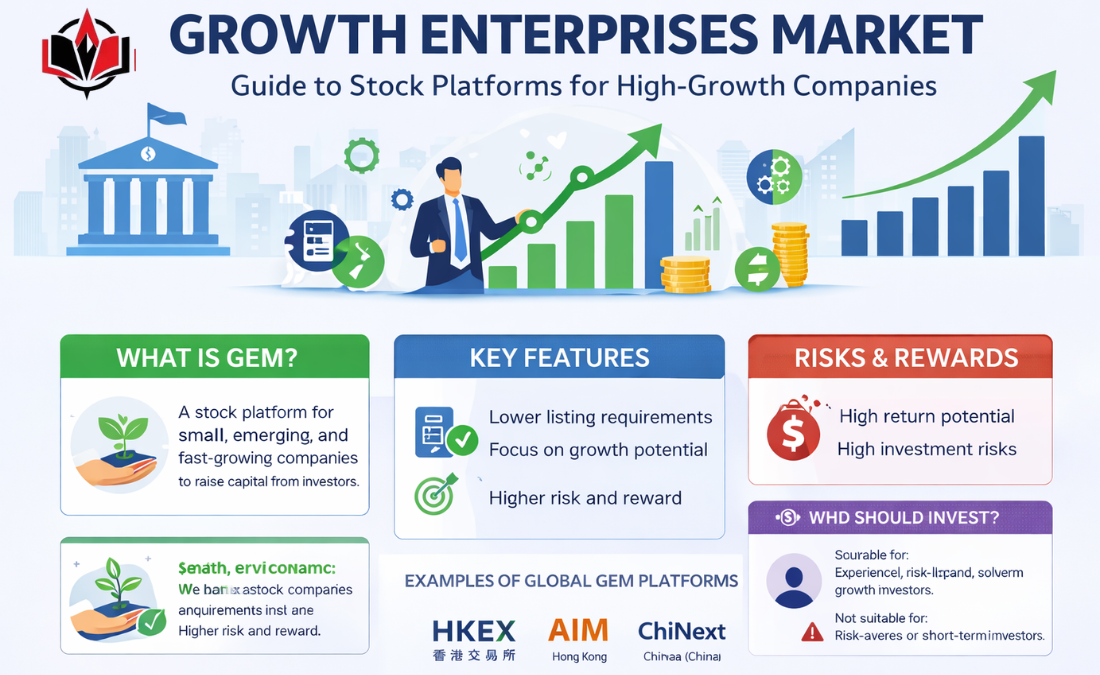
The Growth Enterprises Market (GEM) is a specialized segment of financial stock exchanges designed to support small, emerging, and fast-growing companies that have strong potential but may not yet meet the strict requirements of traditional stock markets. These markets play a crucial role in connecting innovative businesses with investors who are willing to take higher risks in exchange for potentially higher returns.
In today’s global economy, where innovation drives success, Growth Enterprises Markets have become an essential pathway for startups and expanding companies to access capital, build credibility, and scale their operations. This article provides a detailed explanation of what Growth Enterprises Markets are, how they work, their benefits, risks, and their importance in the modern financial ecosystem.
What is a Growth Enterprises Market?
A Growth Enterprises Market is a public trading platform where emerging companies can list their shares and raise funds from investors. Unlike traditional stock exchanges, which usually require companies to have a long financial history and stable profits, GEMs are more flexible and focused on growth potential rather than current performance.
These markets were developed to bridge the gap between:
- Private startups seeking funding
- Large public companies listed on major stock exchanges
In simple terms, GEM acts as a stepping stone for companies moving from being privately owned startups to becoming publicly traded corporations.
Purpose of Growth Enterprises Markets
The main purpose of GEMs is to support innovation and economic development by giving young companies access to capital. Many startups struggle to grow because they lack funding, even if they have strong ideas or technology.
GEMs solve this problem by:
- Providing easier access to public funding
- Encouraging entrepreneurship
- Supporting small and medium enterprises (SMEs)
- Promoting innovation in key industries
By allowing investors to invest early in growing companies, these markets also create opportunities for high financial returns.
Key Features of Growth Enterprises Markets
Growth Enterprises Markets have several unique characteristics that distinguish them from traditional stock exchanges.
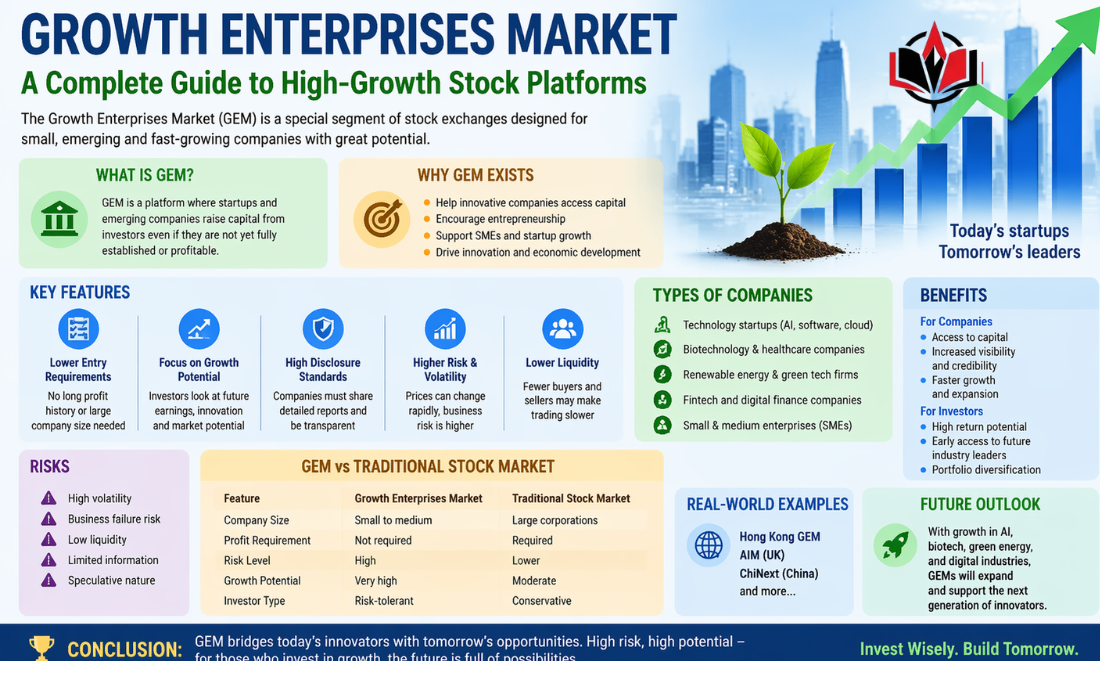
1. Lower Listing Requirements
Companies do not need:
- Long operating histories
- Consistent profitability
- Large market capitalization
This allows young and innovative businesses to enter the market more easily.
2. High Growth Potential Focus
Instead of focusing on current earnings, investors in GEMs evaluate:
- Future growth prospects
- Business models
- Innovation and scalability
- Industry demand
This makes GEMs attractive for venture-style investing.
3. Strong Disclosure Requirements
Even though entry barriers are lower, companies must maintain transparency by:
- Publishing financial reports
- Disclosing risks
- Providing business updates regularly
This ensures investors can make informed decisions.
4. Higher Volatility
Stocks listed in GEMs tend to be more volatile because:
- Companies are still developing
- Earnings are unpredictable
- Market sentiment plays a major role
Prices can rise or fall sharply in short periods.
5. Limited Liquidity
Because these companies are smaller:
- Fewer shares are traded daily
- It may be harder to buy or sell quickly
How Growth Enterprises Markets Work
The process of listing and trading in a GEM generally follows these steps:
Step 1: Company Evaluation
A company applies for listing by providing financial and business details.
Step 2: Approval Process
Regulators review the company’s:
- Business model
- Financial structure
- Growth potential
Step 3: Public Listing
Once approved, shares are offered to the public through an Initial Public Offering (IPO).
Step 4: Trading Begins
Investors can buy and sell shares on the exchange.
Step 5: Ongoing Compliance
The company must regularly report financial performance and business updates.
Types of Companies in Growth Enterprises Markets
GEMs typically include companies from fast-growing and innovative industries such as:
1. Technology Companies
- Artificial intelligence firms
- Software startups
- Cloud computing businesses
2. Biotechnology and Healthcare
- Pharmaceutical research companies
- Medical device innovators
3. Renewable Energy Firms
- Solar energy companies
- Green technology startups
4. Fintech Companies
- Digital payment platforms
- Online banking solutions
5. Small and Medium Enterprises (SMEs)
- Local businesses expanding internationally
- Manufacturing and service-based startups
Advantages of Growth Enterprises Markets
1. Easy Access to Capital
Companies can raise funds without relying solely on banks or private investors.
2. Encourages Innovation
Startups with new ideas get a chance to grow quickly.
3. Early Investment Opportunities
Investors can invest in companies at an early stage, before they become large corporations.
4. Economic Growth
GEMs contribute to job creation and economic expansion by supporting new businesses.
5. Market Visibility
Listing increases a company’s reputation and credibility.
Risks of Growth Enterprises Markets
While GEMs offer high rewards, they also come with significant risks.
1. High Risk of Failure
Many startups fail due to:
- Weak business models
- Market competition
- Financial instability
2. Price Volatility
Stock prices can fluctuate dramatically in short periods.
3. Limited Information
Smaller companies may not have extensive analyst coverage.
4. Low Liquidity
Investors may find it difficult to sell shares quickly.
5. Speculative Nature
Investments are often based on future expectations rather than current performance.
Difference Between Growth Enterprises Market and Traditional Stock Market
| Feature | Growth Enterprises Market | Traditional Stock Market |
|---|---|---|
| Company Size | Small to medium | Large corporations |
| Profit Requirement | Not required | Required |
| Risk Level | High | Lower |
| Growth Potential | Very high | Moderate |
| Investor Type | Risk-tolerant | Conservative |
Importance of Growth Enterprises Markets in the Economy
Growth Enterprises Markets play a critical role in global economic development by:
- Supporting innovation-driven industries
- Helping startups scale globally
- Increasing employment opportunities
- Encouraging foreign and domestic investment
- Strengthening financial ecosystems
They act as a bridge between entrepreneurship and large-scale corporate success.
Who Should Invest in GEM?
These markets are suitable for:
Ideal Investors:
- Experienced investors
- Venture capital participants
- High-risk tolerance individuals
- Long-term growth investors
Not Suitable For:
- Conservative investors
- People seeking stable income
- Short-term traders with low risk appetite
Future of Growth Enterprises Markets
The future of GEMs looks promising due to rapid technological advancement. Industries such as:
- Artificial intelligence
- Green energy
- Biotechnology
- Digital finance
are expanding quickly and will continue to rely on growth markets for funding.
With increasing global startup activity, GEMs are expected to:
- Expand in more countries
- Attract more institutional investors
- Support next-generation tech companies
- Become more regulated and transparent
Conclusion
The Growth Enterprises Market is an essential part of modern financial systems, offering a platform for innovative, high-potential companies to raise capital and grow. While it provides significant opportunities for investors and businesses, it also carries higher risks due to the uncertain nature of emerging companies.
For companies, GEM is a gateway to expansion and global visibility. For investors, it represents a chance to participate early in the success stories of tomorrow’s leading corporations. As global innovation continues to accelerate, Growth Enterprises Markets will remain a vital force in shaping the future economy.
FAQs
1. What is a Growth Enterprises Market?
It is a stock exchange platform designed for small and emerging companies to raise capital and grow their business.
2. Why are Growth Enterprises Markets important?
They help startups access funding, promote innovation, and support economic growth.
3. Are Growth Enterprises Markets risky?
Yes, they are considered high-risk due to volatility and the uncertain performance of young companies.
4. What types of companies are listed on GEM?
Technology firms, biotech companies, fintech startups, renewable energy firms, and SMEs.
5. Can beginners invest in GEM?
Yes, but it is recommended only for investors who understand high-risk, high-reward markets.