
In an age defined by rapid technological change, organizational complexity, and unrelenting pressures for progress, Insetprag has emerged as a novel concept that bridges theory with practice. Though relatively new, it is gaining attention as both a mindset and a practical framework designed to help teams, systems, and organizations embed meaningful improvements without disruptive overhauls.
The word Insetprag itself blends “inset,” meaning something placed within or embedded, and “prag,” referring to pragmatism — prioritizing real-world practicality over abstract theory. This means focusing on small, context-aware innovations that respect existing systems while still driving meaningful progress.
What Is Insetprag?
At its core, Insetprag is a systems-oriented approach that emphasizes embedded improvements and practical actions within existing structures rather than complete replacement or upheaval. The philosophy suggests that true progress often comes from strategically placed insertions that deliver high value with minimal disruption.
Rather than being a rigid methodology with strict steps, Insetprag functions as both a mindset and a guiding framework. It draws on ideas from pragmatism, systems thinking, and iterative improvement. Simply put, Insetprag means improving what already exists by adding practical, context-driven changes that boost performance, adaptability, and value.
The Origins of the Term Insetprag
The term Insetprag is new and emerging, but it builds on older intellectual traditions. The word combines:
- Inset – suggesting something placed or embedded within a larger system.
- Prag – derived from “pragmatism,” a philosophical tradition that values actionable results.
Pragmatism, originating in the late 19th and early 20th centuries, argues that the utility of an idea — its consequences — defines its meaning. Applied to modern systems, Insetprag borrows this emphasis on measurable outcomes and practical impact.
Systems thinking — the study of interdependent components and their relationships — further shapes the concept by highlighting the importance of understanding how changes ripple through a system. Insetprag integrates these ideas, insisting that improvements be embedded within existing contexts and that outcomes matter most.
Core Principles of Insetprag
While Insetprag can be adapted to many contexts, several core principles define its practice:
1. Micro-Interventions for Macro Outcomes
Instead of large, disruptive transformations, Insetprag champions small, targeted changes that can produce disproportionate benefits. Each intervention should be testable, measurable, and adaptable, allowing organizations to learn quickly and minimize risk.
2. Contextual Awareness
Understanding the environment in which a system operates is central. Rather than imposing solutions from the outside, Insetprag encourages practitioners to observe people, processes, and technology before making changes. This helps ensure that insertions align with real needs and avoid unintended consequences.
3. Iteration and Feedback Loops
Improvement is not a one-time activity. Insetprag embeds feedback mechanisms into systems so change becomes iterative — insert, measure, adjust, and scale. This approach reduces waste and supports continuous learning.
4. Pragmatic Feasibility
Not every idea is worth pursuing. A core tenet of Insetprag is choosing interventions that match available resources, capabilities, and ethical considerations. Practicality takes precedence over ideology.
5. Composability and Scalability
Rather than monolithic redesigns, Insetprag emphasizes modular changes that can be combined, replicated, or upgraded over time. This allows flexibility and future growth.
Insetprag in Action: Real-World Examples
One of the strengths of Insetprag is its wide applicability across domains. Below are a few examples that illustrate how it works in real settings:
Technology and Software Development
Instead of rebuilding an entire software platform, developers can use Insetprag by adding modular components — such as microservices or APIs — that improve functionality without disrupting existing workflows. This minimizes risk and accelerates delivery.
Business Operations
Organizations often struggle with complex workflows that have accumulated over time. Insetprag helps by embedding small automation tools, decision aids, or communication checklists directly into existing processes, increasing efficiency and clarity without overhauling operations.
Education and Personal Productivity
In education, Insetprag can mean integrating real-world projects, case studies, or feedback systems within classroom curricula rather than relying solely on traditional lectures. Individuals can apply Insetprag by introducing simple productivity habits or tools into daily routines that deliver outsized benefits.
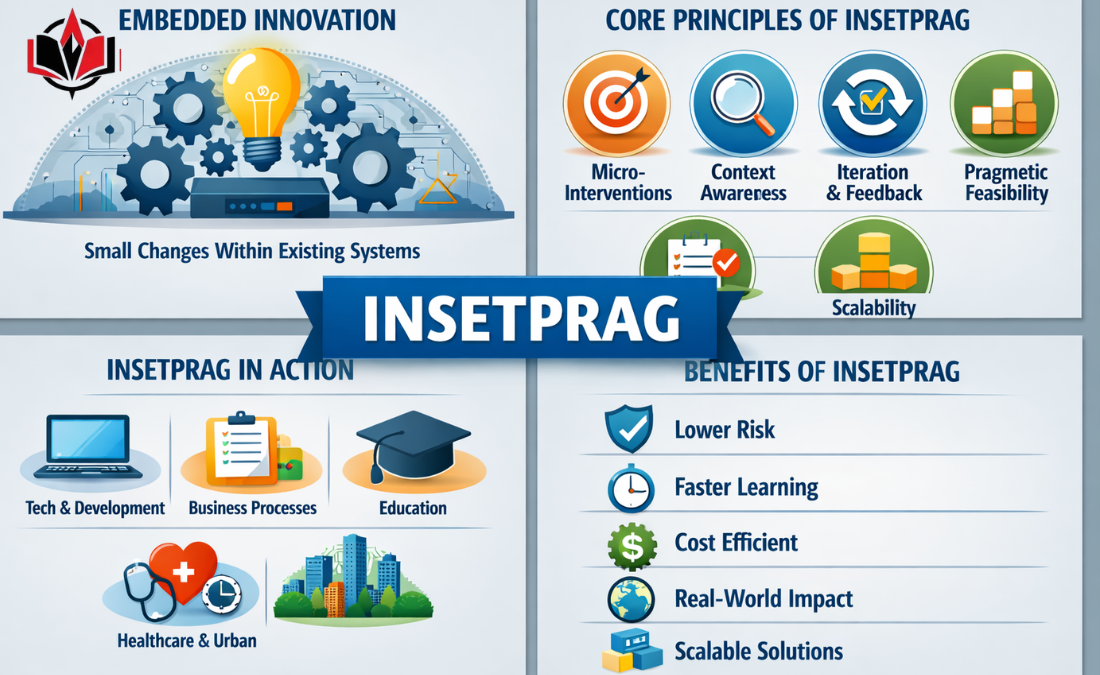
Healthcare and Urban Systems
In complex systems like healthcare or urban infrastructure, small improvements — like embedding sensors, dashboards, or adaptive workflows — can help organizations monitor outcomes and respond dynamically to change.
Benefits of Using Insetprag
Adopting Insetprag can bring several advantages:
- Lower Risk: Small changes reduce the chance of major failures.
- Faster Learning: Quick iterations and feedback drive improvement.
- Cost Efficiency: Embedding change rather than replacing systems saves resources.
- Real-World Impact: Ideas are grounded in practical outcomes.
- Scalability: Modular insertions allow growth and adaptability.
These benefits make Insetprag attractive for businesses, governments, non-profits, and individuals facing uncertainty and complexity.
Challenges and Considerations
While promising, Insetprag is not without challenges:
- Limited Tools and Integration: As a newer framework, Insetprag doesn’t come with an extensive ecosystem of tools.
- Requires Careful Implementation: Embedding changes without disrupting systems demands deep contextual understanding and disciplined measurement.
- Potential for Misinterpretation: Because it can be applied broadly, Insetprag risks being misunderstood as just another buzzword unless its principles are clearly communicated and consistently practiced.
The Future of Insetprag
As technology and organizational systems grow more complex, frameworks like Insetprag may become increasingly relevant. Its principles align with modern trends such as adaptive design, human-centered systems, and feedback-driven improvement.
In a world where static plans often fail under change, Insetprag offers a way to build systems that are efficient, resilient, and meaningful. It has the potential to influence areas ranging from software and business to public policy and urban planning.
Conclusion: Why Insetprag Matters
Insetprag represents a shift in how we approach innovation and improvement. Instead of viewing change as disruptive, it encourages practical, embedded improvements that enhance systems from within.
By combining context awareness, pragmatic feasibility, iterative feedback, and modular scalability, Insetprag provides a framework that respects complexity while still driving progress. Whether applied in technology, business, education, healthcare, or daily life, it equips individuals and organizations with tools to adapt, evolve, and thrive even in uncertain environments.
In a rapidly changing world, Insetprag is not just a concept—it is a philosophy for sustainable, meaningful innovation.