
The global education system is undergoing a massive transformation, driven by rapid technological advancements and evolving workforce demands. The concept of “Droven.io Tech Education Trends” represents a collection of modern developments that are reshaping how people learn, teach, and apply knowledge in the digital age.
These trends highlight a shift from traditional classroom-based education toward a more flexible, personalized, and skill-oriented learning environment. In this comprehensive article, we will explore the most important Droven.io tech education trends, their impact, and why they matter in 2026 and beyond.
🚀 1. Artificial Intelligence Transforming Education
Artificial Intelligence (AI) is at the heart of modern education trends. It is revolutionizing how students interact with content and how educators deliver knowledge.
Personalized Learning Experiences
AI-powered systems analyse student behaviour, performance, and preferences to create customized learning paths. This ensures that:
- Students learn at their own pace
- Weak areas are identified early
- Strengths are further enhanced
Smart Tutoring Systems
AI tutors can provide real-time assistance, answer questions, and adapt to individual learning styles. This reduces dependency on traditional teaching methods.
Automated Administrative Tasks
Educators benefit from AI through:
- Automated grading
- Attendance tracking
- Performance analytics
This allows teachers to focus more on teaching rather than administrative work.
🧠 2. AI Literacy as a Core Skill
As AI becomes deeply integrated into everyday life, understanding how it works is no longer optional.
Key Components of AI Literacy:
- Understanding algorithms
- Evaluating AI-generated content
- Ethical use of AI systems
Students are now being trained not just to use AI tools, but to critically analyze and responsibly apply them.
🕶️ 3. Immersive Learning with VR and AR
Virtual Reality (VR) and Augmented Reality (AR) are creating highly interactive learning environments.
Benefits:
- Real-world simulations
- Hands-on practice without risk
- Enhanced engagement
Practical Applications:
- Medical training simulations
- Engineering design practice
- Historical event exploration
These technologies bridge the gap between theory and practice, making learning more effective.
🌐 4. Hybrid and Flexible Learning Models
The rise of online platforms has led to the adoption of hybrid learning systems that combine digital and physical education.
Features:
- Learn from anywhere
- Flexible schedules
- Self-paced modules
Microlearning Trend
Microlearning focuses on:
- Short lessons
- Quick knowledge absorption
- Better retention
This approach is particularly useful for working professionals and busy learners.
📊 5. Data-Driven Education Systems
Modern education relies heavily on data to improve outcomes.
How Data is Used:
- Monitoring student progress
- Identifying learning gaps
- Improving course design
Advantages:
- Personalized support
- Reduced dropout rates
- Better decision-making
Data analytics ensures that education becomes more efficient and targeted.
🎮 6. Gamification in Learning
Gamification introduces game-like elements into education to boost engagement.
Examples:
- Points and rewards
- Achievement badges
- Leaderboards
Impact:
- Increased motivation
- Better participation
- Improved retention
Learning becomes more interactive and enjoyable, especially for younger audiences.
☁️ 7. Focus on Cloud Computing and Automation Skills
With the growing demand for tech professionals, education is focusing on practical, job-ready skills.
Key Areas:
- Cloud computing
- Automation tools
- DevOps practices
- Data analytics
Students are encouraged to work on real-world projects rather than just theoretical concepts.
🔐 8. Cybersecurity and Data Ethics
As digital systems expand, the importance of security and ethics becomes critical.
Key Topics:
- Data privacy
- Cyber threat prevention
- Ethical AI usage
Educational programs now include these subjects as core components to prepare responsible digital citizens.
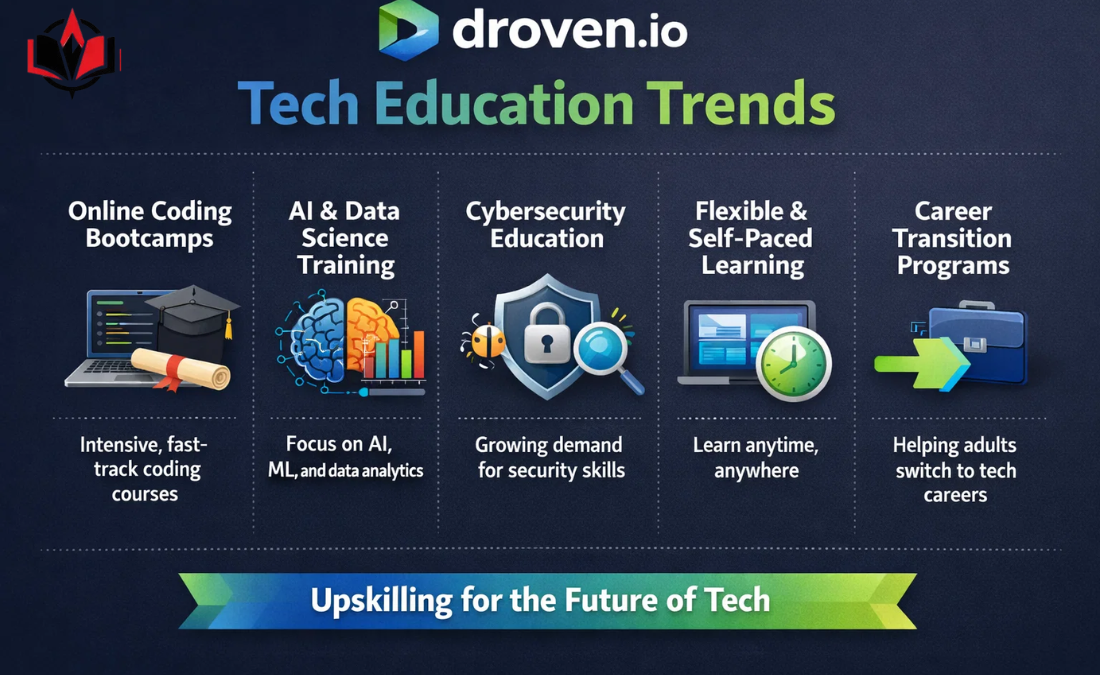
🎓 9. Shift Toward Skills-Based Learning
Traditional degrees are gradually being complemented—or even replaced—by skill-based education.
Changes:
- Emphasis on practical skills
- Rise of online certifications
- Employer focus on ability over degrees
This shift aligns education more closely with industry needs.
🧩 10. Micro-Credentials and Lifelong Learning
Learning is no longer limited to a specific phase of life.
Modern Learning Approach:
- Short-term courses
- Stackable certifications
- Continuous skill development
Why It Matters:
Technology evolves rapidly, and professionals must constantly upgrade their skills to stay relevant.
🔗 11. Emerging Technologies in Education
Beyond AI and VR, several emerging technologies are shaping the future of education.
Examples:
- Internet of Things (IoT) for smart classrooms
- Blockchain for secure credential verification
- Voice AI for accessibility
These innovations make education more inclusive, efficient, and secure.
👨🏫 12. Upskilling Educators
Teachers are also required to adapt to new technologies and teaching methods.
New Expectations:
- Digital literacy
- Use of AI tools
- Modern curriculum design
Educators play a crucial role in implementing these trends effectively.
📈 13. Real-World, Job-Oriented Learning
The ultimate goal of modern education is to prepare learners for real-world challenges.
Key Features:
- Project-based learning
- Industry collaboration
- Practical problem-solving
Students gain hands-on experience that directly applies to their future careers.
🔑 Conclusion
The Droven.io Tech Education Trends clearly demonstrate that education is evolving at an unprecedented pace. The traditional model of learning is being replaced by a more dynamic, flexible, and technology-driven system.
Key Takeaways:
- AI is personalizing education
- Skills are becoming more important than degrees
- Learning is continuous and lifelong
- Technology is central to all educational processes
In this new era, success depends on adaptability, continuous learning, and the ability to work alongside emerging technologies.
❓ FAQs
1. What are Droven.io Tech Education Trends?
They refer to modern technological advancements shaping education, including AI, hybrid learning, and skills-based training.
2. Why is AI important in education?
AI enables personalized learning, automates tasks, and improves overall educational efficiency.
3. What is microlearning?
Microlearning is a method of delivering content in short, focused segments for better understanding and retention.
4. Are traditional degrees becoming obsolete?
Not entirely, but skills-based education and certifications are becoming increasingly important in the job market.
5. How do VR and AR improve learning?
They provide immersive, interactive experiences that enhance understanding and engagement.