
Introduction
The Alhambra Night Tour Attendance and Revenue topic refers to the study of how many visitors attend the night-time guided tours of the Alhambra and how much income these tours generate for cultural and tourism authorities in Spain.
The Alhambra is one of the most visited historical monuments in Europe, located in Granada, Spain. The night tours are a special, limited-access experience that allows visitors to explore parts of the complex under controlled lighting and reduced crowds.
Alhambra
Unlike daytime visits, night tours are more exclusive, quieter, and often considered more atmospheric. Because of this exclusivity, they play an important role in both tourism management and revenue generation.
This article explains everything about attendance trends, revenue structure, pricing logic, and the economic importance of Alhambra night tours.
What Are Alhambra Night Tours?
The Alhambra night tour is a guided evening visit that usually includes access to selected areas such as:
- The Nasrid Palaces (on scheduled nights)
- The Generalife gardens (on separate nights)
These tours are designed to:
- Reduce daytime crowd pressure
- Protect the historical structure
- Offer a premium cultural experience
Unlike daytime tickets, night tours are limited in capacity and often must be booked weeks in advance during peak seasons.
Attendance Overview of Night Tours
Limited Visitor Capacity
One of the defining characteristics of Alhambra night tours is strict visitor control. Authorities intentionally limit the number of visitors per night to protect the monument.
Typical patterns include:
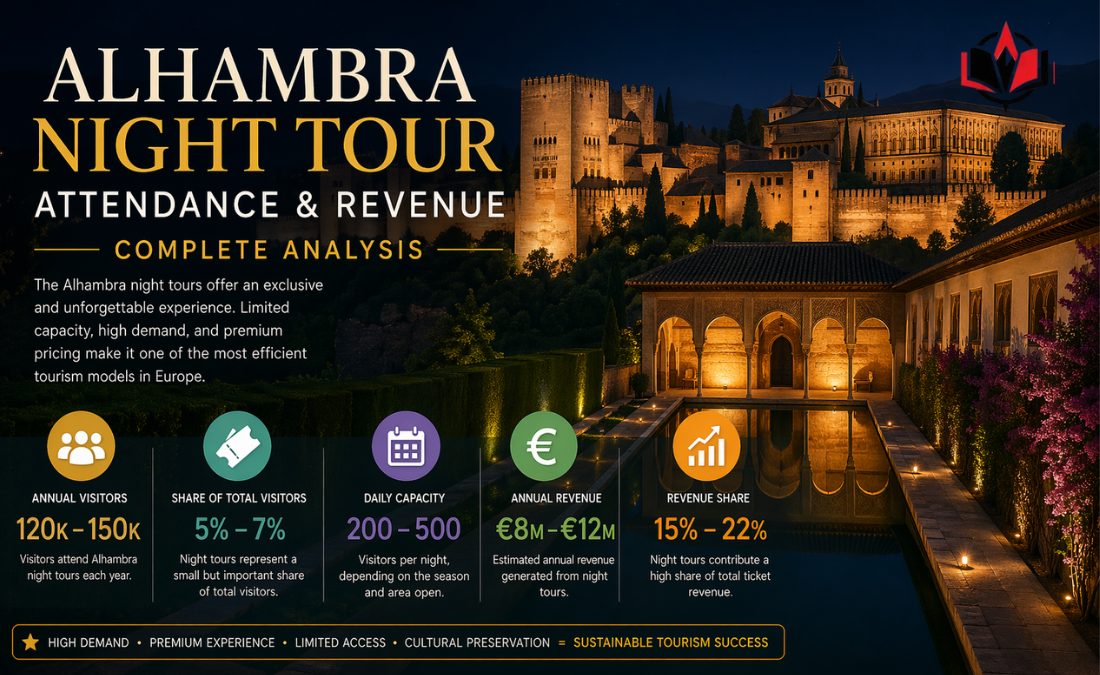
- Around a few hundred visitors per night (depending on season and section open)
- Strict time slots for entry
- No free roaming (guided-only access)
Estimated Annual Attendance
While exact official numbers vary yearly, tourism studies and industry estimates suggest:
- Approximate annual night visitors: 120,000 to 150,000 people
- This represents only a small percentage of total Alhambra visitors
- Night tours usually account for around 5%–7% of total traffic
Seasonal Variation
Attendance is not uniform throughout the year:
- Peak season: April to October (higher tourist inflow)
- Low season: November to February (fewer tours scheduled)
Summer months often sell out quickly due to high demand and limited capacity.
Revenue Structure of Night Tours
Ticket Pricing
Night tours are more expensive than standard daytime tickets due to:
- Exclusive access
- Guided experience
- Limited capacity
- Cultural preservation costs
Prices vary depending on the section (Nasrid Palaces or Generalife) and booking type, but generally fall into a premium range compared to standard entry.
Estimated Revenue Contribution
Based on tourism economic reports and sector analysis:
- Annual revenue from night tours: estimated between €8 million and €12 million (varies by year and demand conditions)
- In conservative estimates, it may be lower depending on pricing models and visitor volume assumptions
- Night tours contribute a significant share of high-margin income despite low attendance
Why Night Tours Generate High Revenue
Even though night tours have fewer visitors, they are economically efficient. This is due to several factors:
1. Premium Pricing Strategy
Night tours are positioned as a premium cultural experience. Visitors are willing to pay more for:
- Exclusive access
- Night-time atmosphere
- Reduced crowds
This increases revenue per visitor significantly.
2. Limited Supply Creates High Demand
Since only a fixed number of tickets are available:
- Scarcity increases perceived value
- Tickets often sell out quickly
- Secondary tourism demand increases pricing stability
3. High Visitor Spending Behavior
Night tour visitors often:
- Book guided packages
- Combine visits with nearby tourism services
- Spend more on accommodation and dining
This indirectly boosts the local economy.
4. Lower Operational Pressure
Night tours:
- Require fewer staff than daytime operations
- Have controlled routes, reducing maintenance stress
- Help preserve the monument, reducing long-term conservation costs
Economic Importance of Night Tours
The Alhambra night tours are not just a tourism product—they are part of a broader cultural economy strategy.
1. Cultural Preservation Funding
Revenue generated helps fund:
- Restoration projects
- Structural maintenance
- Heritage conservation programs
2. Sustainable Tourism Model
Night tours support sustainability by:
- Reducing daytime overcrowding
- Spreading tourist traffic across time slots
- Protecting fragile historical architecture
3. Local Economic Impact
Beyond ticket revenue, night tours support:
- Hotels in Granada
- Local restaurants
- Transportation services
- Tour guide employment
This creates a multiplier effect in the regional economy.
Attendance vs Revenue Relationship
One of the most interesting aspects is the imbalance between attendance and revenue:
- Low attendance (limited capacity)
- High revenue (premium pricing)
This creates a model where:
Fewer visitors generate disproportionately high income per person.
This is the opposite of mass tourism models, where high volume is required for profitability.
Day Tours vs Night Tours
| Feature | Day Tours | Night Tours |
|---|---|---|
| Visitor volume | Very high | Low |
| Pricing | Standard | Premium |
| Experience type | Crowded exploration | Exclusive guided visit |
| Revenue model | Volume-based | Value-based |
| Conservation impact | Higher pressure | Controlled impact |
Night tours act as a strategic complement to daytime tourism.
Challenges in Night Tour Management
Despite their success, night tours face several challenges:
1. Ticket Scarcity Issues
High demand leads to:
- Rapid sellouts
- Resale market pressure
- Visitor dissatisfaction
2. Conservation Limits
Authorities cannot increase capacity significantly without risking damage to the site.
3. Seasonal Dependency
Revenue fluctuates based on tourism seasons and global travel trends.
Future Outlook
Experts predict that Alhambra night tours will continue to:
- Maintain controlled capacity
- Increase digital booking efficiency
- Enhance premium experiences
- Possibly adjust pricing to manage demand
However, expansion is unlikely due to strict preservation policies.
Conclusion
The Alhambra night tour attendance and revenue system represents a highly efficient cultural tourism model. Although visitor numbers are relatively low due to strict conservation limits, revenue remains strong because of premium pricing and high demand.
Alhambra
In simple terms, the night tours show how cultural heritage can be preserved while still generating significant economic value. The balance between limited attendance and high revenue makes it one of the most successful examples of sustainable tourism in Europe.
FAQs
1. What is the Alhambra night tour?
It is a guided evening visit of selected areas of the Alhambra monument in Granada, Spain, offering a quieter and more exclusive experience than daytime tours.
2. How many people attend the night tours each year?
Estimates suggest around 120,000 to 150,000 visitors annually, depending on tourism demand and seasonal schedules.
3. Why are night tours more expensive than daytime visits?
They are premium experiences with limited capacity, guided access, and special atmospheric lighting, which increases their value.
4. How much revenue do Alhambra night tours generate?
Annual revenue is estimated to be between €8 million and €12 million, depending on visitor numbers and pricing variations.
5. Why are night tour tickets limited?
Capacity is restricted to protect the historic structure, reduce wear and tear, and maintain a high-quality visitor experience.